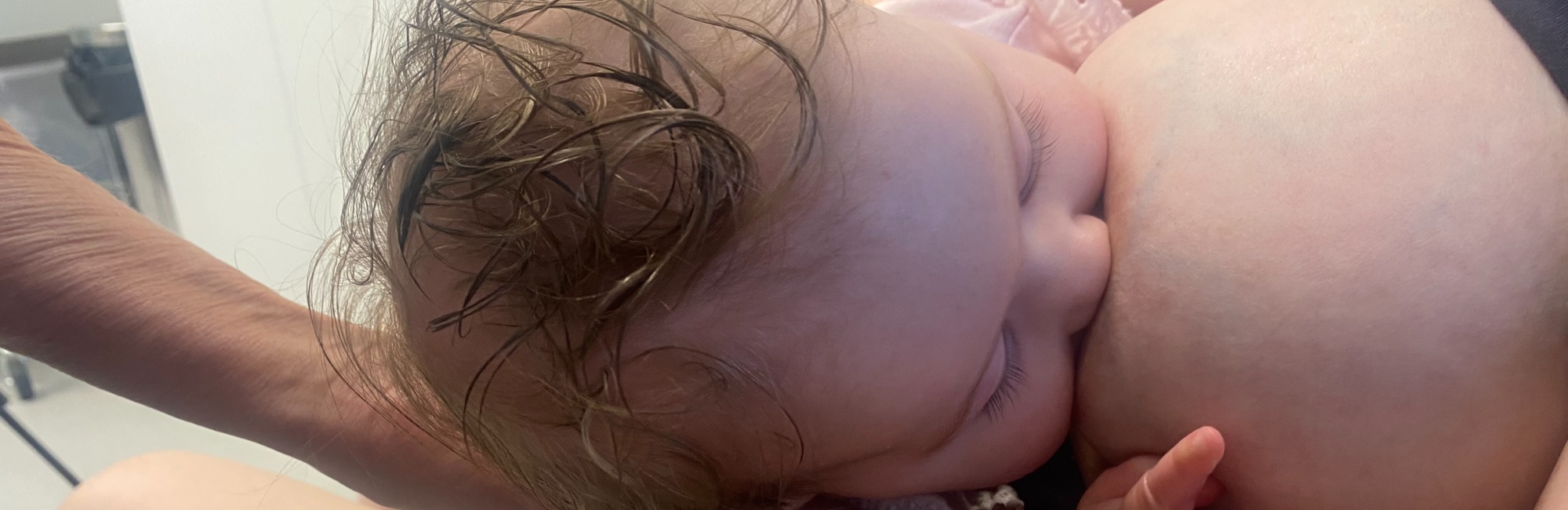

About experimentation and workability in breastfeeding

I invite you to experiment with the four steps of the gestalt method of fit and hold, and to discover what works for you and your baby.
Fitting your baby to your breast is like the rest of parenting: approximate, and imperfect. Things usually don't come together ideally all at once. We find ourselves settling for what's workable at any moment in time, which is how we develop resilience.
So as you experiment with fit and hold, remember to aim for workability, not perfection.
Our bodies are all quite unique, and it can take time to sort out how to fit your own and your baby's unique anatomies together. Over time, with experimentation and practice, most women and their babies can work it out together for easy, pain-free and efficient breastfeeding. (Though the truth is that for complex reasons breastfeeding may never completely come together for some women and their babies.)
The sooner we get in with effective help once challenges arise, the better.
You can find out about experimentation and resilience when you're caring for a baby here.
Selected references
Douglas PS, Keogh R. Gestalt breastfeeding: helping mothers and infants optimise positional stability and intra-oral breast tissue volume for effective, pain-free milk transfer. Journal of Human Lactation. 2017;33(3):509–518.
Douglas PS, Geddes DB. Practice-based interpretation of ultrasound studies leads the way to less pharmaceutical and surgical intervention for breastfeeding babies and more effective clinical support. Midwifery. 2018;58:145–155.
Douglas PS, Perrella SL, Geddes DT. A brief gestalt intervention changes ultrasound measures of tongue movement during breastfeeding: case series. BMC Pregnancy and Childbirth. 2022;22(1):94. DOI: 10.1186/s12884-12021-04363-12887.